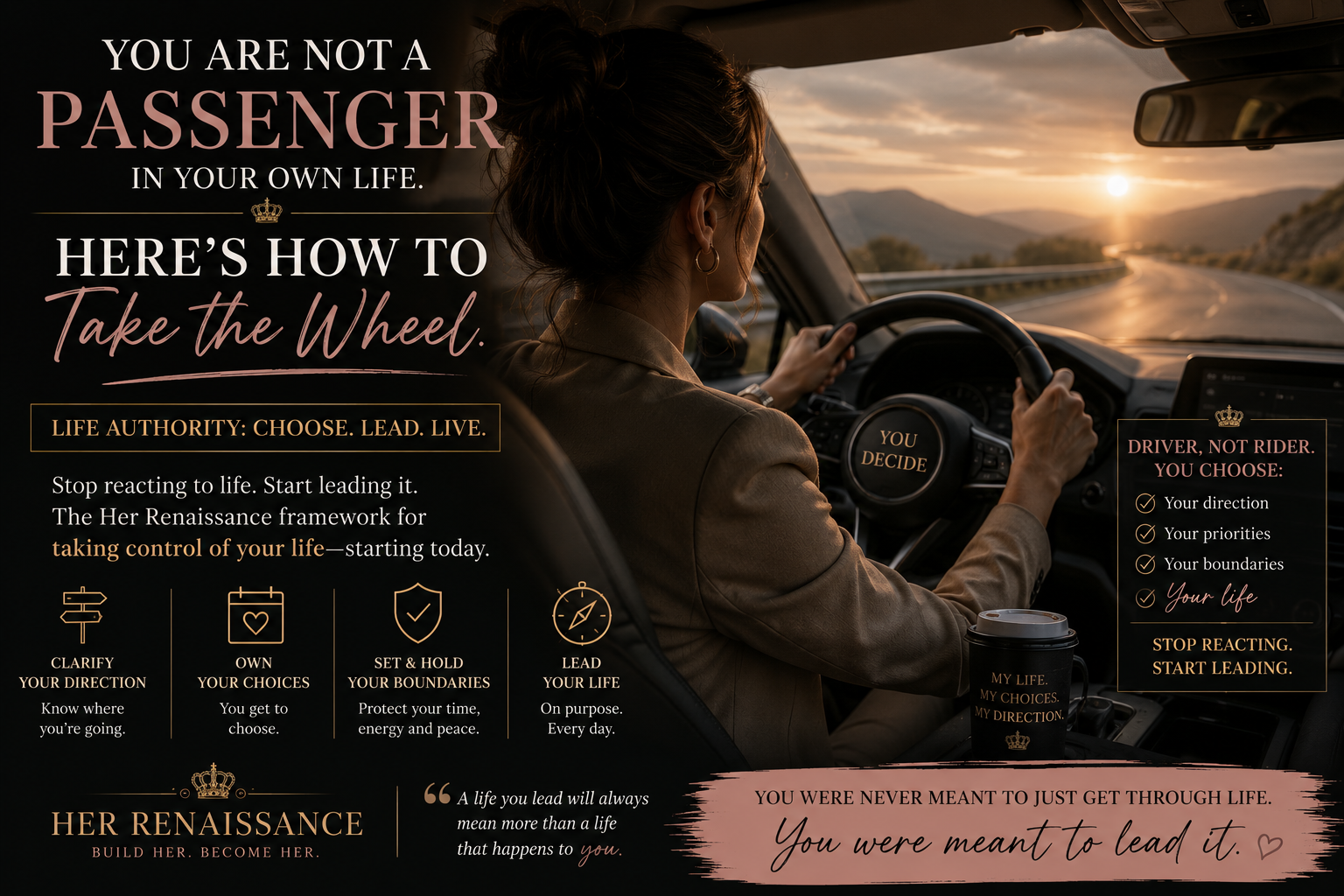
You Are Not a Passenger in Your Own Life. Here’s How to Take the Wheel.
Think about your last week. Not the highlight reel version — the honest one. How much of it did you actually choose, and how much of it simply happened to you, and you responded?
You woke up and reacted to the first message on your phone. You said yes to something you didn’t want to do because saying no felt like too much effort. You adjusted your schedule, again, around someone else’s plans. You absorbed someone’s mood, someone’s request, someone’s crisis, and you moved through the day accommodating it, managing it, surviving it.
By the time you got to bed, you were exhausted — not from doing too much, but from choosing too little. You were in the car. You just weren’t driving it.
This is more common than you think, and it rarely announces itself. Nobody wakes up one day and decides to become a passenger in their own life. It happens quietly, one accommodation at a time, until reacting becomes the only mode you know.
The Passenger Pattern
Here’s how to recognize it. A passenger reacts. A driver chooses. A passenger adjusts to whatever is happening around her. A driver decides what happens next. A passenger absorbs other people’s moods, plans, and demands as though they were her own. A driver holds her own direction, even when other people’s weather is loud around her.
The passenger pattern doesn’t look dramatic from the outside. It looks like a woman who is endlessly accommodating, endlessly flexible, endlessly “easygoing.” People often praise this. What they don’t see is the quiet exhaustion underneath it — the sense of watching your own life happen to you, rather than living it.
You can be extremely busy as a passenger. You can be successful by external measures as a passenger. You can raise a family, run a household, hold down a career — all while never once being asked, by yourself, what you actually want any of it to look like. Busyness is not proof you’re driving. It’s often just proof the car is moving, regardless of who has their hands on the wheel.
Why We End Up in the Passenger Seat
Nobody chooses this consciously. It accumulates, usually for reasons that made sense at the time.
Many of us learned early that accommodating others was safer than asserting ourselves. Maybe conflict in your home growing up was frightening, so you became skilled at reading the room and adjusting before anyone even had to ask. Maybe you were praised for being easy, low-maintenance, agreeable — and so agreeableness became the identity you built your entire self around, long after it stopped serving you.
There’s also simple erosion. Life fills up. Deadlines, other people’s needs, the sheer velocity of daily obligations — and somewhere in the noise, the question “what do I actually want here?” gets quietly dropped, because it takes more energy to ask than to just keep reacting. Reacting is the path of least resistance. It requires no decision, no risk, no responsibility. It also, over years, hollows out a life.
And for many women specifically, there is an added layer: being told, directly or indirectly, that wanting things for yourself is selfish. That your role is to accommodate, to hold everyone else’s needs before your own, to be endlessly available. Under that belief, choosing your own direction can feel, quite literally, like a moral risk. So the passenger seat starts to feel not just familiar, but safe.
The Cost of Riding Instead of Driving
Here’s what staying in the passenger seat actually costs you, beyond the exhaustion: it costs you the life that was actually yours to build.
A passenger’s life gets shaped entirely by other people’s decisions, other people’s crises, other people’s timelines. Years pass. The passenger looks up one day and realizes she has been extremely busy, extremely accommodating, and somehow nowhere close to the life she actually wanted — because she was never the one steering toward it. She was simply along for whoever else’s ride was loudest that day.
This is not a small cost. This is the difference between a life that happened to you and a life you actually built. And the tragedy is that from the outside, both can look nearly identical — full calendars, responsibilities met, people cared for. The difference lives entirely in who was actually choosing.
The Reframe: Life Authority
This is the shift Her Renaissance calls Life Authority — the state of leading your own existence, rather than enduring it.
Life Authority is not about controlling everything, and it is not about becoming rigid, selfish, or unavailable to the people you love. It is about recognizing that you are allowed — actually, required — to be the one making the decisions in your own life, rather than the one perpetually responding to everyone else’s.
A woman operating in Life Authority still accommodates people. She still adjusts, still flexes, still shows up for others. The difference is that she does so by choice, from a place of authority over her own direction — not by default, because she never considered another option. The actions can look identical from the outside. The internal posture is entirely different.
This is the difference between the driver who chooses to pull over and help someone, and the passenger who has never once held the wheel.
Naming the Areas Where You’ve Been a Passenger
You cannot reclaim authority over a life you haven’t honestly assessed. So before anything else, you need to name — specifically, without softening it — the areas where you have quietly handed the wheel to someone or something else.
This is usually not your whole life at once. It is usually two or three specific areas where the pattern is loudest. It might be your time — always available, always interruptible, never protected. It might be your finances — decisions made reactively, around whoever asked first, rather than deliberately. It might be a relationship where you have stopped stating what you want and simply started absorbing what the other person wants instead. It might be your own body, your own health, quietly deprioritized because everyone else’s needs got there first.
Sit with this honestly. Ask yourself: in what parts of my life do I consistently react instead of choose? Where do I find myself, again and again, adjusting to someone else’s plan instead of stating my own? The areas that make you a little uncomfortable to name are usually the right ones.
Claiming the Wheel
Once you’ve named where you’ve been a passenger, the next step is not a dramatic overhaul. It is a deliberate, specific reclaiming — one area at a time.
For each area you named, ask: what would it look like if I were actually driving here, instead of riding along? Not a fantasy version. A concrete, specific answer. If your time is the area, driving might look like blocking two protected hours a day that nobody else’s request can touch. If it’s a relationship, driving might look like stating, clearly, what you actually want instead of waiting to be asked, or worse, waiting to be told.
This is not about announcing a grand transformation to everyone around you. It is about making one deliberate choice, today, in one of the areas you named — a choice that comes from your own direction, not from reacting to whoever spoke first. Then doing it again tomorrow. Life Authority is not seized once. It is claimed daily, decision by decision, until choosing becomes the default instead of the exception.
What This Looks Like in Practice
Picture a woman who realizes, honestly, that she has not made an independent decision about her own calendar in years — every hour gets absorbed by whoever asks for it first, loudest, or most urgently. She names this as one of her three passenger areas. The next morning, before checking her phone, she blocks ninety minutes for the one project that actually matters to her — not negotiable, not available for reassignment. When a request comes in for that slot, she does not automatically yield. She checks it against her own direction first, and only then decides. It is a small shift. It is also the first time in years she has actually driven, rather than simply been carried along by whatever showed up first.
The Life You Actually Build
You were never meant to move through your own existence as a passenger, absorbing whatever direction other people’s demands happened to be pulling. You were meant to lead it — deliberately, with your hands actually on the wheel, choosing your direction even when it would be easier to simply react to whoever is loudest.
This does not happen by accident, and it does not happen by waiting for circumstances to finally settle down enough for you to take over. It happens the moment you name, honestly, where you’ve handed control away — and the moment after that, when you take it back.
By this evening, you can know exactly which three areas of your life you’ve been riding through instead of driving. That is where Life Authority begins.
Tik Tok: https://www.tiktok.com/@angeliquebenadie
YouTube: https://www.youtube.com/@HerRenaissance2025
Get started with a workbook: https://www.herrenaissance.co.za/shop/