Why Your Boundaries Keep Collapsing (And It’s Not Because You’re “Too Flexible”)
You did it. You finally said the thing. “I won’t be answering work calls after 6pm.” “I need you to stop speaking to me like that.” “I’m not lending money again until the last loan is paid back.” You felt the rush of it — that clean, solid feeling of finally standing up for yourself.
For about 48 hours.
Then someone pushed back. A raised eyebrow. A guilt trip. A “but this is different, it’s an emergency.” A silence that felt like punishment. And you caved. You answered the call. You let the comment slide. You handed over the money.
And afterward, you told yourself a story to make it feel okay: I’m just being flexible.
You are not being flexible. You are watching your boundary dissolve the moment it costs you something — and calling the collapse a virtue so it doesn’t have to feel like what it actually is: a boundary that was never actually load-bearing.
The Difference Between Flexibility and Collapse
Flexibility is a conscious, considered choice made from a place of strength. It looks like reviewing a boundary and deciding, calmly, that this particular situation genuinely warrants an exception — and making that exception on your own terms, without pressure, without guilt, without your heart racing.
Collapse is different. Collapse happens under pressure. It is reactive, not considered. It happens the moment someone frowns, sighs, raises their voice, or simply waits you out. You do not decide to abandon the boundary. The boundary gets taken from you, and you dress the theft up as a decision so it hurts less.
The tell is simple: flexibility feels like peace. Collapse feels like relief mixed with a low, sour shame. If you feel that particular flavor of relief — the “thank goodness that’s over” feeling — after giving in, you already know, somewhere in your body, that it was not a considered choice. It was a cave.
Why the Boundary Doesn’t Hold
Here is the uncomfortable truth: most boundaries fail not because the rule was wrong, but because the identity behind the rule was never actually settled.
A boundary is just a rule. “I don’t answer calls after 6pm.” Rules are easy to state and easy to abandon, because a rule by itself has no weight behind it. It is a sentence, not a structure. The moment someone applies enough pressure — guilt, anger, a sad story, a raised voice — the rule bends, because there was nothing underneath it strong enough to resist the pressure.
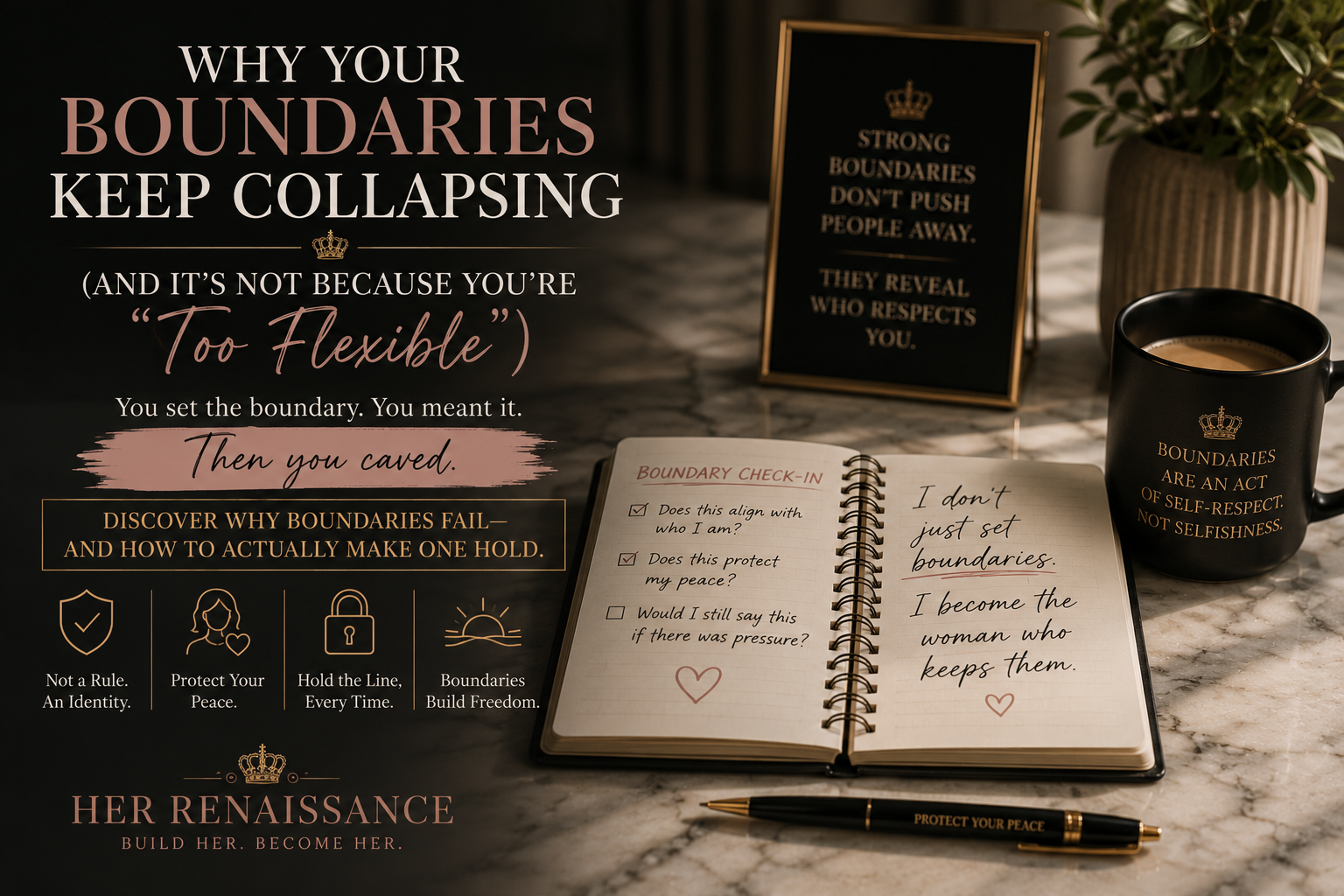
What actually holds a boundary in place is not the rule. It’s the identity behind it. Not “I have a rule about not answering calls after 6pm,” but “I am a woman who protects her evenings, period.” Rules bend. Identity doesn’t. And most of us have spent years building rules without ever doing the harder work of building the identity that would actually make those rules stick.
This is why you can read every boundary-setting article on the internet, memorize every scripted response, and still fold the first time someone you love looks disappointed in you. The scripts were never the problem. The absence of a settled identity underneath them was.
Why We Cave
Let’s be honest about what actually happens in the moment of collapse, because understanding it is the first step to interrupting it.
Someone pushes back on your boundary, and your body responds as though it is under threat — because, in a very real sense, it is. Disapproval from someone you love registers, biologically, as danger. Your nervous system does not distinguish neatly between “this person might reject me” and “this person might harm me.” It just registers threat, and it wants the threat to end as quickly as possible. Caving ends the tension immediately. It is the fastest route back to safety, even though it costs you the very thing you were trying to protect.
There’s also a deeper pattern many women carry, often from childhood: the belief that love is conditional on being agreeable. That saying no risks the relationship itself. If you grew up in a home where boundaries were met with punishment, withdrawal, or rage, your nervous system learned early that holding your ground was dangerous. Caving is not weakness. It is a survival strategy that made sense once and has simply outlived its usefulness.
Understanding this matters, because it means the fix is not “try harder to say no.” Willpower was never the missing ingredient. What is missing is a settled identity strong enough to hold steady when the old threat response fires.
The Reframe: Rules Bend, Identity Doesn’t
This is the heart of it. Stop trying to defend a rule. Start building an identity.
A rule says: “I won’t do X.” An identity says: “I am the kind of woman who doesn’t do X — not because of a policy, but because it’s incompatible with who I am.” The rule can be argued with. The identity cannot, because it is not up for debate the way a policy is. Nobody can guilt you out of who you are. They can only guilt you out of a rule you haven’t yet made part of your identity.
This is why boundaries genuinely held by confident, secure people often look effortless from the outside. It’s not that they never face pushback. It’s that the pushback lands on something solid instead of something hollow. There is no internal negotiation happening, because there is no gap between the rule and the self behind it.
How to Draw a Boundary and Actually Keep It
Here is the practical process for closing that gap — for turning a rule you keep abandoning into an identity that holds.
Step 1: Name the Identity Behind the Boundary
Before you state the rule, get clear on the identity underneath it. Not “I don’t answer calls after 6pm” but “I am a woman who protects her evenings, because her evenings are for her family and her rest, and that is not negotiable.” The rule is now an expression of who you are, not an isolated policy someone can argue their way around.
Step 2: Expect the Pushback, Don’t Be Ambushed By It
Most boundaries collapse because the pushback catches you off guard, and surprise makes you reactive. Before you draw the boundary, decide in advance: this person will likely push back, and here is exactly what that will sound like. When it happens exactly as predicted, it no longer destabilizes you. You already knew it was coming.
Step 3: Respond From Identity, Not From the Argument
When pushback comes, do not re-argue the rule. Re-state the identity, calmly, without escalating. “I understand this feels inconvenient. I’m still not available after 6pm.” You are not trying to win the debate. You are simply not participating in one, because your identity isn’t up for a vote.
Step 4: Let the Discomfort Happen Without Rescuing It
The other person’s disappointment, silence, or irritation is not an emergency you need to fix immediately. It is simply a feeling they are having, and they are allowed to have it without you abandoning your boundary to manage it for them. Sit in the discomfort without caving to end it faster.
Step 5: Collect the Evidence That You Held
After you hold the boundary under real pressure, name it. “I held this. The relationship did not end. I survived the disapproval.” This is what actually builds the settled identity over time — not the boundary itself, but the accumulated proof that you can hold one even when it costs you something.
What This Looks Like in Real Life
Picture a woman who has said for years that she won’t lend money to a family member who never pays her back. Every time, the request comes wrapped in urgency and guilt, and every time, she caves — then calls it generosity. Using this process, she names the identity first: I am a woman who is generous on her own terms, not under pressure. She expects the guilt trip before it arrives. When it comes, she doesn’t re-argue the family history or defend her reasoning. She simply says, “I love you, and I’m not able to help with this,” and lets the silence that follows sit there, uncomfortable, without rushing to fix it. It is hard. It is also the first time in years the boundary has actually held — because for the first time, there was an identity behind it strong enough to carry the weight.
The Boundary Was Never the Weak Point
If your boundaries keep collapsing, the problem was never that you are “too flexible,” and it was never that you simply need a better script. The problem is that you have been building rules on top of an identity that hasn’t yet caught up to them. Build the identity first, and the boundary stops needing your constant defense — because it is no longer a rule you’re protecting. It’s simply who you are.
Boundaries are meant to be respected, not bent. And that respect starts with you refusing to bend first.
Tik Tok: https://www.tiktok.com/@angeliquebenadie
YouTube: https://www.youtube.com/@HerRenaissance2025
Get started with a workbook: https://www.herrenaissance.co.za/shop/