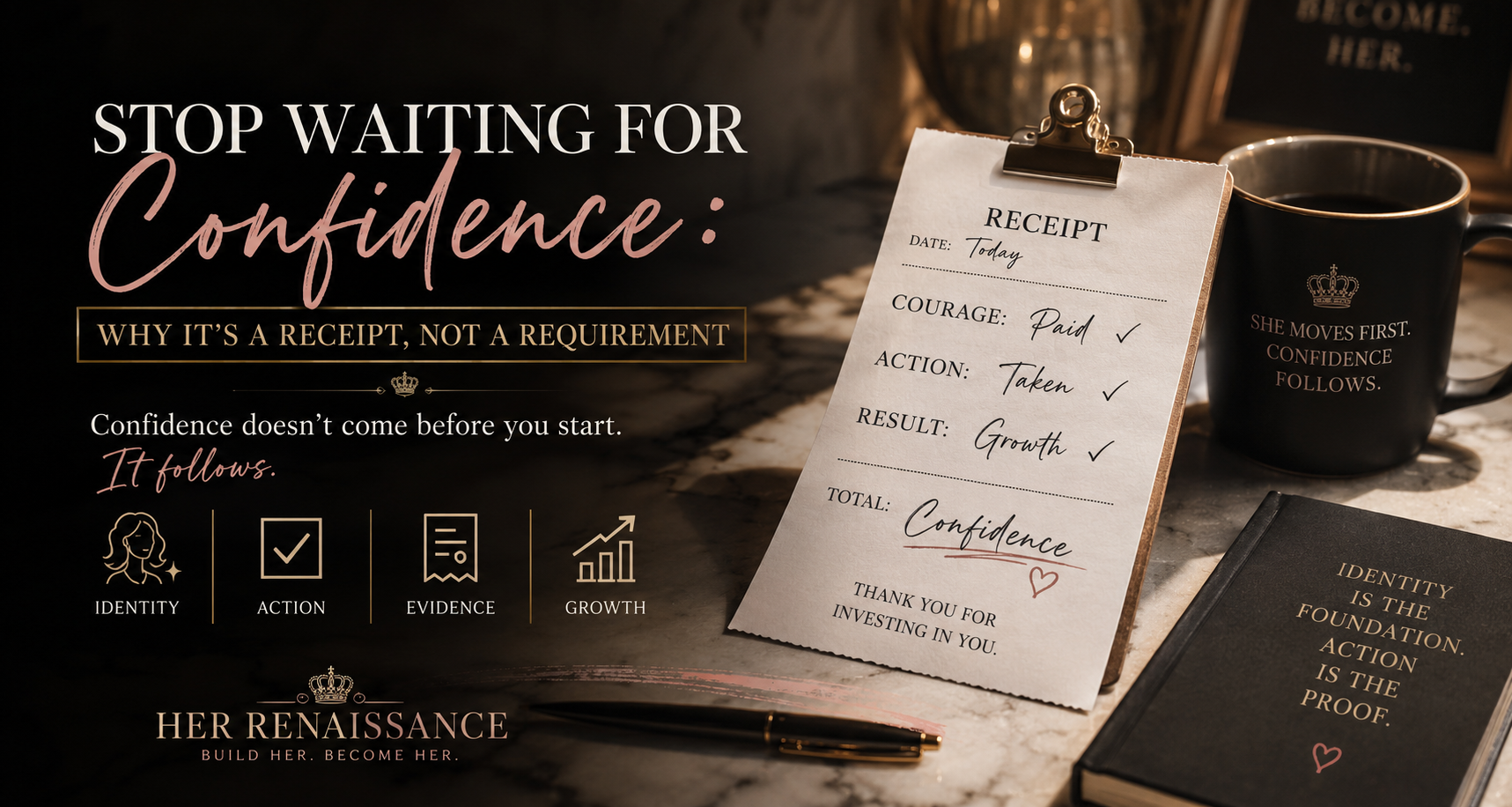
Stop Waiting for Confidence: Why It’s a Receipt, Not a Requirement
Stop Waiting for Confidence: Why It’s a Receipt, Not a Requirement
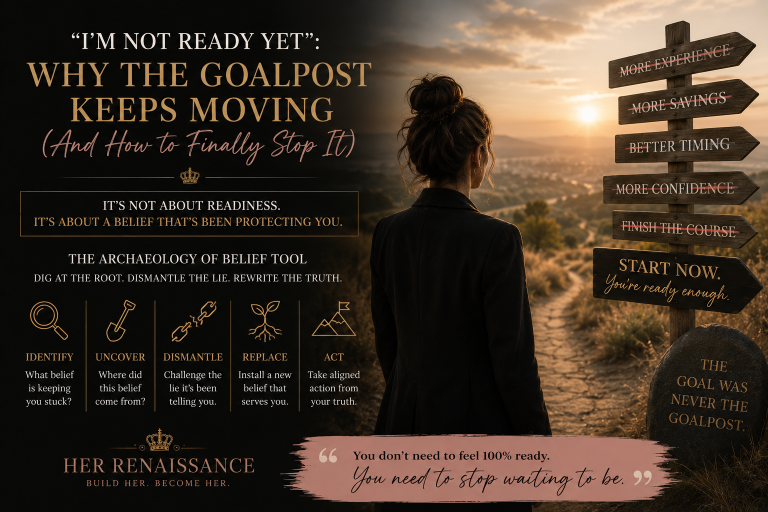
You have been waiting.
Waiting for the fear to lift before you post the thing. Waiting for the shake in your hands to settle before you send the application. Waiting for that solid, grounded, I’ve-got-this feeling before you finally start the business, end the relationship, apply for the role, or say the thing you have been rehearsing in the shower for six months.
You have been checking for confidence the way you check a tracking number. Refreshing. Waiting for the notification that says your package has arrived.
Here is the truth nobody told you: it is never coming. Not because you are broken, not because you are behind, and not because everyone else got a head start you missed. It is not coming because confidence was never a package to begin with. It was never sitting in a warehouse somewhere, waiting to be shipped to the version of you who finally “feels ready.”
Confidence is not the prerequisite for starting. It is the receipt you get after you do.
The Myth of the Confidence Package
Somewhere along the way, most of us picked up a quiet belief: that confident people feel a certain way before they act. That they walk into the room, the interview, the launch, the hard conversation, already steady. Already sure. Already sorted.
So we wait to feel that way too. We tell ourselves, “Once I feel more confident, I’ll post consistently.” “Once I feel sure of myself, I’ll raise my rates.” “Once the fear goes, I’ll say yes to the opportunity.”
But talk to anyone who has actually done something brave — started the business, left the toxic situation, stood up in front of the room — and you will hear some version of the same confession: I was terrified. I did it anyway. And somewhere in the doing, the fear started to loosen its grip.
Confidence did not arrive first and grant permission. It showed up after the action, as evidence that the action was survivable. As proof that you did not, in fact, fall apart. That is the receipt. Not the ticket in.
Why We Keep Waiting Anyway
If this is true — if confidence follows action rather than preceding it — why do so many of us keep waiting for the feeling anyway?
Because waiting feels safer than moving. If you have not started yet, you have not failed yet. The dream is still intact, still perfect, still untested. The moment you act, you risk finding out that you are not as capable, as talented, or as ready as you hoped. Waiting protects the fantasy.
There is also a subtler trap: we have been taught, often without realizing it, that feelings are supposed to come before obedience, before faith, before movement. That we should feel led before we step out. That we should feel called before we say yes. But feelings are unreliable narrators. They are shaped by fatigue, hormones, old wounds, and yesterday’s disappointment. They were never designed to be the gatekeepers of your obedience or your growth.
If you have spent years waiting for a feeling that refuses to show up on schedule, please hear this: you are not lacking discipline. You have simply been waiting at the wrong door.
The Problem With Waiting for Confidence
Waiting does not just delay your goals. It quietly reshapes your identity.
Every day you wait “until you feel ready,” you reinforce a belief that says: I am someone who needs to feel a certain way before I can move. That belief becomes load-bearing. It starts holding up other rooms in your life — your relationships, your finances, your calling. You begin outsourcing your obedience to your emotions, and emotions are not qualified for that job.
Meanwhile, the world does not pause for your process. Opportunities close. Doors that were open at 25 look different at 35. The version of you who could have started five years ago has already been quietly grieving the years lost to waiting.
This is not meant to shame you. It is meant to wake you up gently, the way a friend would, over coffee, with her hand on your arm: sis, the feeling was never going to come first. Let’s talk about what actually works.
The Reframe: Confidence Is the Receipt, Not the Prerequisite
Here is the shift at the center of Her Renaissance’s approach to identity and action: confidence is evidence, not entry fee.
Think about a receipt. You do not receive a receipt before you make a purchase. The transaction happens first — the decision, the exchange, the risk of handing over your card — and the receipt is simply the proof that it occurred.
Confidence works the same way. You do not receive it before the act of courage. You receive it because you acted. It is proof, collected after the fact, that you can do hard things. That you survived the discomfort. That the version of you who took the step is now, undeniably, someone who has taken steps before.
This reframe does something powerful: it removes the impossible condition you have been placing on yourself. You no longer need to manufacture a feeling before you are allowed to move. You need only to move — and let the feeling catch up, which it always does, later, quieter, and more durable than the fragile “confidence” you were chasing in the first place.
The Her Renaissance Identity Activation Framework
This is where the Her Renaissance Identity Activation framework comes in. It is not a motivational trick to “hype yourself up.” It is a structured way to move first, so that confidence has something to attach itself to.
Step 1: Name the Identity, Not the Outcome
Instead of asking, “What do I want to achieve?” ask, “Who do I need to become to do this?” Outcomes are distant and abstract. Identity is immediate. You do not need to become a bestselling author to write today. You only need to act like a woman who writes. Identity Activation starts by naming that identity clearly, in one sentence: I am a woman who shows up even when she is scared.
Step 2: Choose the Smallest Believable Action
Confidence is not built by giant leaps; it is built by small, repeated acts of proof. The framework asks you to choose an action so small it is almost impossible to talk yourself out of it — sending the message, opening the document, recording sixty seconds of video — because the goal is not the size of the action. The goal is the evidence it produces.
Step 3: Act Before You Feel Ready
This is the non-negotiable center of the framework. You do the small action before the fear subsides, not after. You let your hands move while your stomach is still in knots. This single decision — to act with the fear rather than after it — is what starts generating the receipts.
Step 4: Collect the Evidence
After the action, pause and name what just happened, honestly. “I sent it, and I did not die. I said no, and the relationship did not collapse. I posted the video, and the sky did not fall.” This is the receipt. Write it down. This is not optional — the evidence needs to be collected consciously, or it slips past unnoticed and does nothing to rebuild your identity.
Step 5: Let the Evidence Compound
One receipt does not make you fearless. But ten receipts, twenty, fifty — repeated over weeks — start to form an undeniable pattern. Eventually you are no longer telling yourself a story about who you hope to become. You are simply looking at the evidence of who you already are.
What This Looks Like in Real Life
Picture a woman who has wanted to raise her prices for two years but has been waiting to “feel confident enough.” Under Identity Activation, she does not wait for the feeling. She names the identity — a woman who charges what her work is worth — chooses the smallest believable action — sending one new-client quote at the new rate — and sends it while her hands are still shaking. The client says yes. That is the receipt. She does it again the following week. Ten quotes later, she is not hoping to feel confident about her pricing. She has the evidence that she already is.
This is not about becoming fearless. It is about becoming someone who no longer requires the absence of fear as a condition for obedience.
A Different Way to Wait
If you are a woman of faith, you have likely heard that we are meant to walk by faith and not by sight. Confidence, as the world defines it, is a form of sight — a felt certainty you can see and measure before you commit. But faith was never meant to wait for sight. It moves first, in the dark, trusting that the ground will hold. The receipts — the confidence, the peace, the steadiness — arrive after the step, as confirmation, not as a precondition.
This is not a call to be reckless. It is a call to stop confusing readiness with certainty. You will likely never feel fully certain. You can, however, become someone who moves anyway — and lets the proof accumulate behind her.
Your Next Step
You do not need to wait for the tracking number anymore. The confidence you have been waiting for is not lost in transit. It was never shipped, because it does not exist until you generate it yourself, one small act of courage at a time.
If you are ready to stop waiting and start collecting your own evidence, the Her Renaissance Identity Activation framework walks you through exactly how — step by step, receipt by receipt — until the woman you are becoming is no longer a hope, but a fact you can point to.
Want more?
Subscribe to our YouTube channel: https://www.youtube.com/@HerRenaissance2025