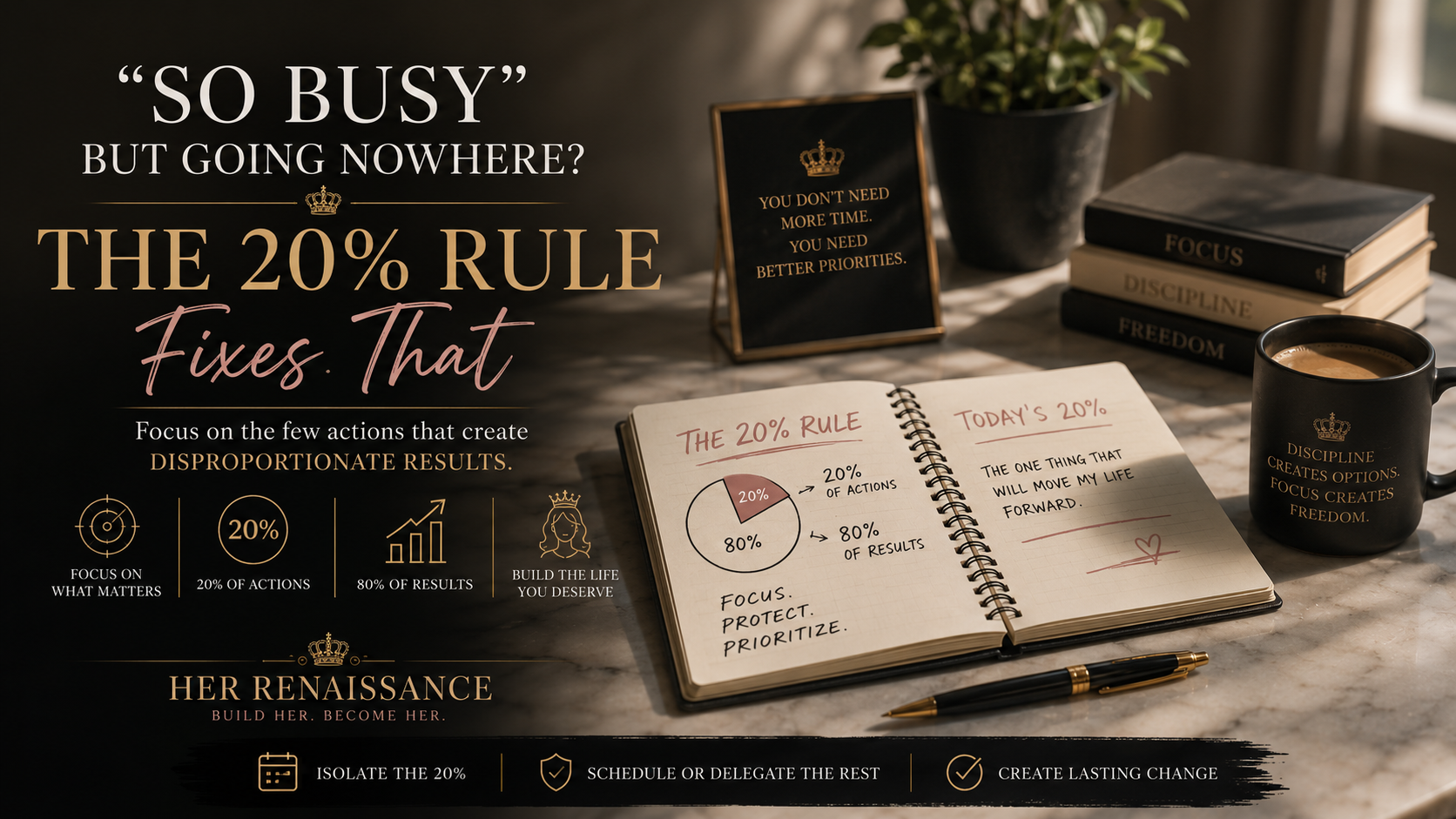
“So Busy” But Going Nowhere? The 20% Rule Fixes That
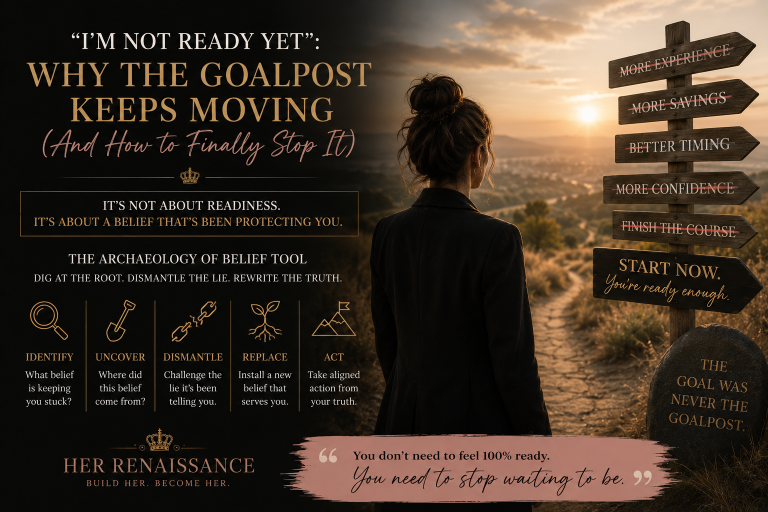
Busy but not productive.
Ask yourself something honest: what did you actually do today?
Not what filled your hours. Not what kept you moving from one task to the next, phone buzzing, inbox refreshing, to-do list growing faster than you could cross things off. What did you do — the one thing that, if you look back in six months, will have actually moved your life forward?
If you’re sitting there struggling to name it, you are not alone, and you are not lazy. You are simply busy in a way that has stopped being useful. You have confused motion with progress. And until you separate the two, you will keep ending every day exhausted, and every year in roughly the same place.
The Busy Trap
Busyness feels productive. That is exactly why it is so dangerous.
When you are answering messages, attending meetings, tidying the house, reorganizing the filing system, checking things off a list — you get a hit of accomplishment. Your brain registers “task complete” and rewards you with a small sense of relief. But relief is not the same as progress. A full calendar is not the same as a moving life.
Most of what fills our days is not actually driving the outcomes we say we want. It is administrative. It is reactive. It is other people’s priorities dressed up as urgent. And because it feels like work, we rarely stop to question whether it is the right work.
This is how a woman can work a twelve-hour day and still feel, lying in bed that night, a quiet unease she cannot quite name. It is the unease of a life being managed, not built.
Why We Default to Busy
There is a reason busyness is so seductive, and it is not simply about time management. It is about safety.
Being busy with small, manageable tasks feels safe because it does not expose you to the risk of the one big thing that actually matters — the thing that could fail, could be judged, could reveal that you are not as ready as you hoped. So instead of doing the one hard, exposing, high-leverage task, we do fifteen easy, low-stakes ones. We answer the emails instead of writing the proposal. We reorganize the desk instead of making the phone call. We attend the meeting instead of building the thing the meeting was supposed to be about.
Busyness becomes a socially acceptable form of avoidance. Nobody questions a busy woman. Everyone questions a woman who says no to half her calendar to protect two hours for the one thing that scares her.
There is also a subtler trap here for women specifically: busyness has been quietly rebranded as virtue. We are praised for how much we juggle, how little we rest, how selflessly we show up for everyone else’s priorities. So we keep collecting tasks the way some people collect achievements — as proof of our worth — without ever asking whether the tasks are actually building anything.
The Cost of Undifferentiated Busy
Here is what undifferentiated busyness actually costs you: it costs you the compounding effect of focused effort.
Most meaningful results in life — a thriving business, a restored marriage, a body that is genuinely healthy, a body of work that outlives you — are not built from a hundred scattered, mediocre efforts. They are built from a small number of disproportionately powerful actions, repeated consistently, protected fiercely from everything else competing for your time.
When you spread your energy evenly across everything on your list, you dilute the very actions capable of producing outsized results. You give the email inbox the same energy as the client proposal that could double your income. You give the group chat the same energy as the conversation that could actually repair your marriage. Everything gets a little bit of you, and nothing gets enough of you to actually change.
This is not a discipline failure. It is a design failure. Your days were never structured to protect what matters. They were structured to absorb whatever showed up.
The Reframe: Precision, Not Hustle
This is where most productivity advice gets it wrong. It tells you to do more, wake up earlier, hustle harder, squeeze more into the same twenty-four hours. That advice does not fix the underlying problem. It just makes you more efficiently busy at the wrong things.
The Her Renaissance approach is different, and it rests on one principle: precision beats volume.
Roughly 80% of your meaningful results come from about 20% of your actions. The other 80% of what fills your day — the tasks, the meetings, the admin, the reactive fires — produces a disproportionately small share of what actually matters. This is not a hustle-culture productivity hack. It is the opposite of hustle culture. Hustle culture says do everything, faster. Precision says find the few things that matter, and do almost nothing else.
This is not about working harder. It is about working narrower, and letting that narrowness do the heavy lifting.
The Her Renaissance 20% Rule
The 20% Rule is the practical tool for putting this principle to work in your actual life, not just your philosophy. Here is how it works.
Step 1: Audit Honestly
List everything that occupied your time this past week — every task, meeting, obligation, and habit. Be ruthless and specific. This is not the moment to be generous with yourself about how “necessary” everything felt.
Step 2: Identify the Disproportionate Actions
For each item, ask one question: if I did more of this and less of everything else, would my life visibly change in three months? Most items will fail this test immediately. A small handful will pass. Those are your 20%. For a business owner, it might be sales conversations and content creation. For a marriage, it might be undistracted time and honest conversation. For your health, it might simply be consistent movement and sleep. The 20% is rarely more than two or three items.
Step 3: Protect the 20% Ruthlessly
Once you have identified your disproportionate actions, they get protected time — scheduled, non-negotiable, treated with the same seriousness as a doctor’s appointment. This is not optional busywork you get to if there’s time left over. This goes first, before the calendar fills with everything else.
Step 4: Schedule, Delegate, or Delete the Rest
Everything that did not make the 20% list gets one of three treatments. It gets scheduled into a specific, contained time block instead of bleeding across your whole day. It gets delegated to someone else — a team member, a service, a family member — because your energy is too valuable to spend on tasks anyone else could do. Or it gets deleted entirely, because on honest inspection, it was never actually necessary. It was simply habitual.
Step 5: Review Weekly
The 20% shifts over time as your life and goals shift. What mattered most three months ago may not be what matters most now. Revisit the audit weekly, keep the list short, and stay honest about what is actually producing results versus what simply feels productive.
What This Looks Like in Practice
Picture a woman running her own business who feels perpetually behind despite twelve-hour days. When she runs the audit honestly, she discovers she is spending most of her time on emails, social media scrolling disguised as “market research,” and rearranging her workspace — while the two things that actually grow her business, sales calls and creating new offers, get pushed to “whenever there’s time,” which is never.
Under the 20% Rule, sales calls and offer creation become the protected, scheduled first block of her day. Email gets batched into one 30-minute window. Social media research gets a strict 15-minute cap. Admin tasks get delegated to a virtual assistant. Within weeks, her days feel shorter, not longer — because she is finally spending her energy where it compounds, instead of scattering it across everything that simply demanded her attention.
A Word on What This Isn’t
This is not permission to be lazy, and it is not a call to abandon your responsibilities. Some of what fills your day genuinely has to happen — the school run, the invoices, the unglamorous maintenance of a life. The 20% Rule does not eliminate that. It simply refuses to let it masquerade as the point of your life. Maintenance keeps things from falling apart. It rarely builds anything new. Your 20% is what builds.
This also is not hustle culture in a new outfit. Hustle culture tells you your worth is measured by how much you do. The 20% Rule tells you your worth is not up for measurement at all — but if you want to move your life forward, precision, not volume, is what will do it.
Your Next Step
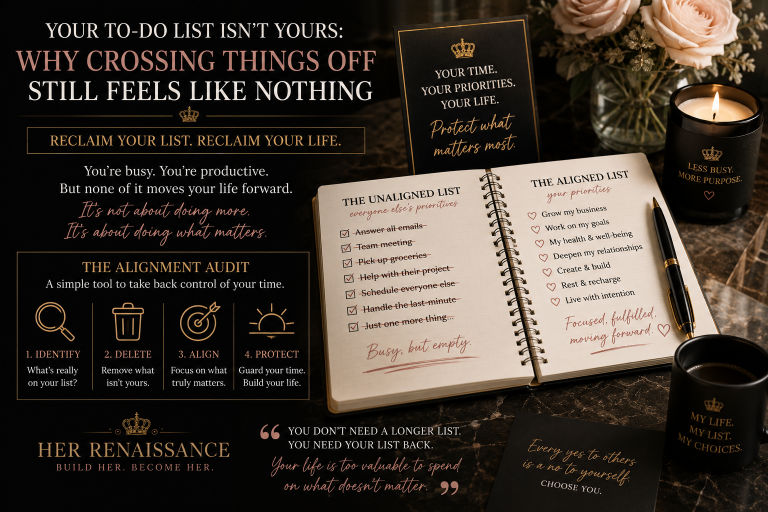
You do not need a longer to-do list. You do not need to wake up earlier or squeeze more into a day that is already full. You need to find the two or three actions that are quietly doing all the work — and then have the courage to protect them, even when everything else in your life is loudly demanding equal attention.
Run the audit this week. Be honest about what actually moves your life forward versus what simply keeps you occupied. Then schedule, delegate, or delete everything else. This is not about doing more. It is about finally doing what matters.
Tik Tok: https://www.tiktok.com/@angeliquebenadie
YouTube: https://www.youtube.com/@HerRenaissance2025
Get started with a workbook: https://www.herrenaissance.co.za/shop/