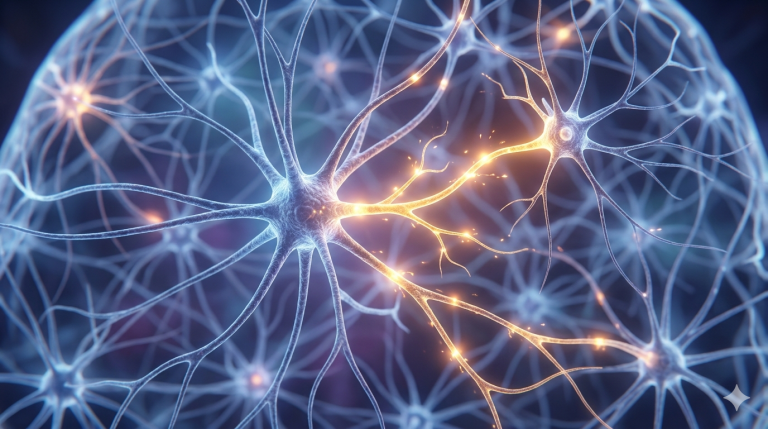

The Chemistry of Self-Sabotage: Why Your Brain Mistakes Growth for Danger.
The Chemistry of Self-Sabotage: Why Your Brain Mistakes Growth for Danger.
We like to think of ourselves as logical, rational creatures who actively move toward happiness, prosperity, and peace. We build elaborate five-year plans, design beautiful mood boards, and invest heavily in our education and businesses because we genuinely desire to step into our next, most powerful era.
Why is it, then, that the closer we get to achieving our deepest desires, the more erratic our behavior becomes?
Why do we suddenly pick a fight with a supportive partner right when the relationship feels safe? Why do we catch a mysterious cold the weekend before a massive professional presentation? Why do we find ourselves mindlessly scrolling through social media for four hours when we have a critical, game-changing proposal sitting on our desk?
The self-help industry calls this self-sabotage, framing it as a lack of willpower, a sign of low self-esteem, or a spiritual block.
But your brain is not trying to sabotage you. In fact, it is trying to save your life.
When you understand the evolutionary biology and internal chemistry behind your resistance, you realize that your mind isn’t working against you—it is simply misinterpreting growth as a mortal danger. And until you learn how to recalibrate that chemical response, you will always remain a hostage to your own comfort zone.
The Evolution of the Cavewoman’s Brain
To understand why your brain treats expansion like a threat, we have to travel back several hundred thousand years. The human brain evolved in an incredibly hostile, volatile environment where survival was a daily gamble.
In that ancient landscape, anything that was unfamiliar was statistically likely to kill you.
If our ancestors stayed within the known boundaries of their tribe and territory, they generally survived. The water was safe, the paths were known, and the dangers were predictable. But if an adventurous cavewoman decided to wander past the ridge into an unexplored valley just to see what was there, she was highly likely to be eaten by a predator or poisoned by an unknown plant.
Through natural selection, the human brain developed a profound, hardwired bias: predictable discomfort is always preferable to unpredictable expansion.
Fast forward to the modern day. Your physical environment has radically changed, but your primitive brain architecture remains exactly the same. It does not know the difference between an uncharted prehistoric valley and a new, high-visibility business venture. It cannot distinguish between a saber-toothed tiger and the vulnerability of launching a new program like Her Renaissance.
When you decide to step out of your old, small identity, your primitive brain flags that shift as an existential threat. It sees you leaving the safety of the known tribe. It looks at your new, grand vision and says, “This is unfamiliar. Therefore, this is dangerous. We must force her back behind the ridge immediately.”
The Chemical High-Jack
The moment your brain senses this perceived danger, it doesn’t send you a polite intellectual memo. It launches a full-scale chemical coup.
The hypothalamus signals your adrenal glands to immediately release a massive surge of stress hormones: adrenaline, noradrenaline, and cortisol. This chemical cocktail is designed to prepare your body for intense physical survival. It diverts blood flow away from your internal organs and your prefrontal cortex—the part of your brain responsible for creativity, long-term planning, and high-level strategy—and shunts it directly into your large muscle groups so you can run or fight.
This creates a state of physiological hyper-arousal. Your brain enters a survival loop.
When you sit down at your desk to execute your big goals while flooded with cortisol, you cannot think clearly. You cannot innovate. Your brain is screaming that you are under attack. To relieve this intense, agonizing internal pressure, your subconscious looks for the fastest route back to safety.
And what is the fastest way to lower your cortisol levels and signal to your brain that the danger has passed? To stop doing the hard thing.
The moment you close the laptop, put off the sales call, or delete the draft, your brain perceives that you have run away from the dangerous valley and returned to the cave. The chemical flood recedes. A small hit of dopamine is released as a reward for surviving. You feel an immediate wave of relief.
You haven’t self-sabotaged because you are lazy or incapable. You have self-sabotaged because your brain chemically rewarded you for shrinking back into your comfort zone.
The Upper Limit Problem
In her psychological work, researchers often refer to this phenomenon as an “Upper Limit Problem.” We each possess an internal, subconscious thermostat for how much love, success, visibility, and wealth we are allowed to experience.
This thermostat was calibrated early in life based on our environment, our families, and our early cultural conditioning.
When our lives are operating within our established thermal comfort zone, our nervous system feels regulated. But when we experience a sudden spike in success—a massive financial month, a beautiful period of deep intimacy, or a moment of high public recognition—we pass our internal baseline. We hit our upper limit.
Even though these experiences are objectively positive, our primitive operating system registers the sudden spike as an anomaly. It assumes something is wrong. It triggers the alarm bells, causing us to unconsciously create a crisis—a financial mistake, a physical illness, or an interpersonal conflict—to bleed off the excess positive energy and bring our internal thermostat back down to a level of familiar, predictable discomfort.
If you do not consciously alter your baseline, you will spend your entire life bouncing against an invisible ceiling, constantly tearing down what you build because your chemistry cannot handle the magnitude of your own expansion.
Calibrating Your Subconscious Thermostat
So, how do we break the chemical loop of self-sabotage? We do it by changing our relationship with discomfort.
Most people believe that the presence of fear, hesitation, or anxiety means they are doing something wrong or that they aren’t ready to lead. But when you look through the lens of neuroscience and evolutionary biology, you realize that anxiety is the tax your primitive brain levies on your growth.
The friction you feel is not a stop sign; it is a directional arrow confirming that you have officially left the cave.
When you step into your power with The Compassionate Authority framework, you stop trying to fight or eliminate the fear. You expect it. When you feel the chemical surge of adrenaline before a big launch or a hard boundary, you don’t interpret it as danger. You look at it with deep psychological mastery and say: “Ah, my brain sees me expanding. Thank you for trying to keep me safe, but I am not dying. We are just growing.”
You must teach your nervous system that you can tolerate the heat of your own success. By remaining regulated, taking slow breaths, and executing your strategy even while the survival alarms are ringing, you gradually recalibrate your internal thermostat. You show your brain that the new valley is not only safe, but it is also your new home.
The resistance isn’t proof that you are broken. It’s proof that you are right on the edge of your renaissance. Stop running back to the cave. Step over the ridge and claim what is yours.