The moment I realised I wasn’t broken — I was just running the wrong software.
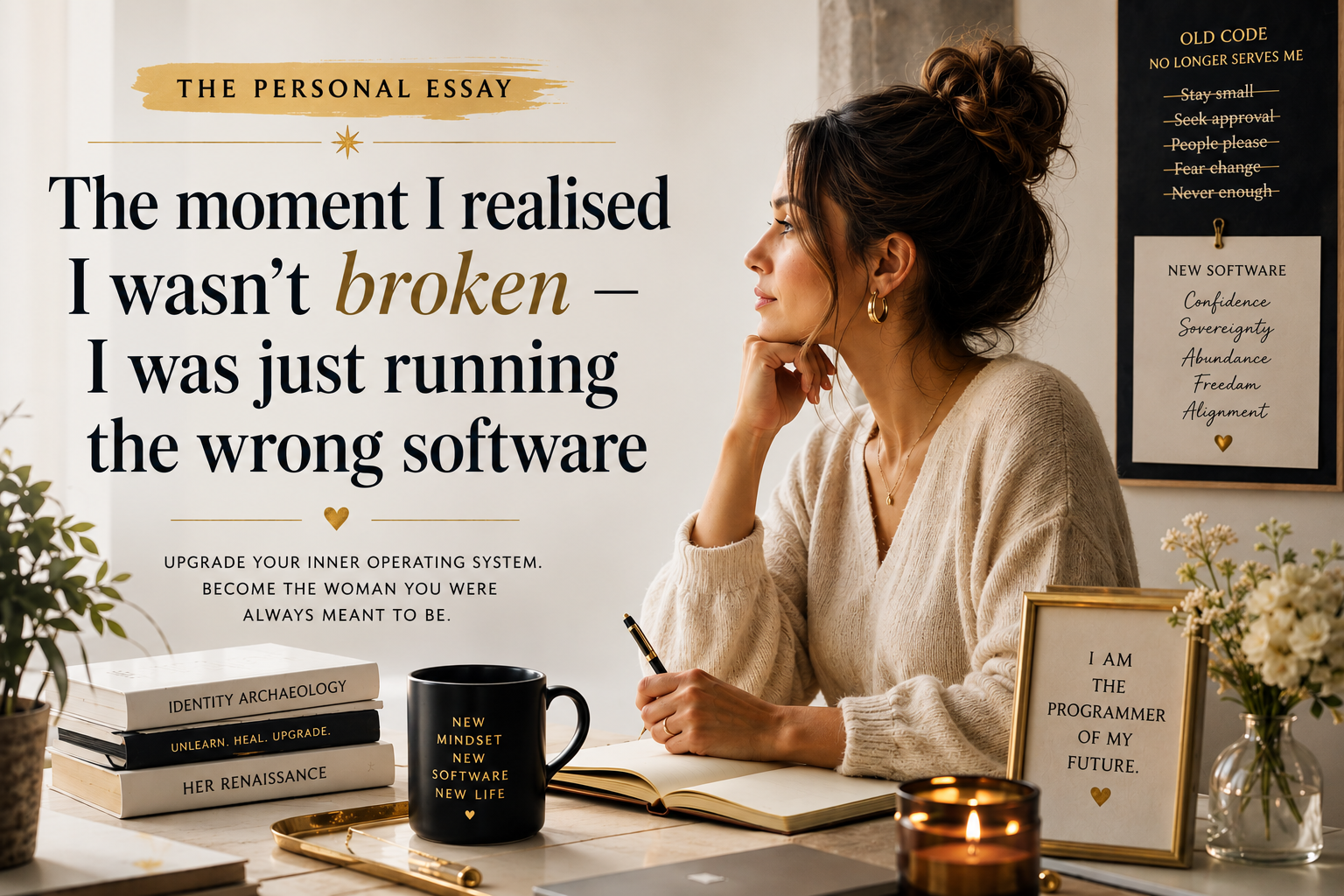
The moment I realised I wasn’t broken — I was just running the wrong software.
For years, I carried a quiet, suffocating suspicion that I was inherently flawed.
You know the feeling. It’s the one that sits heavy in your chest at 3:00 AM when the house is silent, and the weight of your own unfulfilled potential presses down on you. It’s the exhausting loop of setting goals, gathering momentum, and then—just as the horizon comes into view—watching your own hands pull the emergency brake.
I used to look at other women who seemed to navigate their lives with an organic, effortless flow and wonder what secret ingredient they had been given at birth that I had somehow missed. I assumed I was missing a gear. I believed, with a deep and mournful certainty, that I was simply broken.
But a few years ago, sitting amidst the wreckage of another beautifully planned strategy that had mysteriously stalled, the truth hit me with the force of a physical blow.
I wasn’t broken. I didn’t need to be fixed. I was just trying to run high-level, visionary software on an outdated, corrupted operating system.
The machinery of my mind, my ambition, and my heart was perfectly fine. But the background programming—the unconscious rules, the ancient survival mechanisms, the identity I had constructed just to get through my hardest seasons—was completely incompatible with the woman I was trying to become.
And until you change the operating system, no amount of new goals, positive thinking, or superficial lifestyle changes will ever stick.
The Glitch in the Strategy
We are told by the mainstream self-help industry that if we want to change our lives, we just need more discipline. We need better habits. We need to wake up earlier, work harder, and force our way through the resistance.
This is not only bad advice; it is a profound misunderstanding of human psychology.
Think about your computer or your phone. When a piece of software is outdated, or when the underlying operating system is bogged down by old, corrupt code, what happens when you try to install a massive, high-powered new application? The system freezes. The screen locks up. The device overheats and forces a hard shutdown.
The device isn’t broken. It is actually doing exactly what it was programmed to do: protecting itself from a load it cannot support.
This is exactly what is happening when you experience self-sabotage. You decide you want to build a business, speak with authority, claim your financial independence, or step into a room with unshakeable confidence. That is the new software. It’s beautiful, sleek, and powerful.
But underneath that desire lies an operating system installed when you were ten, fifteen, or twenty-five years old. An operating system built on survival codes like:
- Stay invisible, because attention brings criticism.
- Your worth is directly tied to how much you sacrifice for others.
- If you become too successful, the people you love will leave you.
- You are only safe if you are accommodating.
When you try to run the software of a powerful, self-governing woman on an operating system ruled by old fear, a systemic conflict occurs. Your subconscious looks at your new goals, flags them as a threat to your historical safety, and triggers a forced shutdown. You don’t fail because you lack willpower. You fail because your old operating system is working perfectly to keep you exactly where it thinks you are safe.
Identity Archaeology: Digging Up the Codes
To upgrade the system, you have to be willing to look at the code. This is what I call Identity Archaeology. It is the intentional, sometimes uncomfortable work of digging beneath the surface of your current behavior to find the artifacts of who you used to be.
Most of us are living our lives in reaction to ghosts. We are letting the wounded version of ourselves, the version that had to hustle for validation or shrink to avoid conflict, sit in the director’s chair of our adult lives.
When I began my own archaeology, I found codes I didn’t even realize were running. I found an old program that insisted total self-reliance was the only true safety—a code that made asking for support feel like a dangerous weakness. I found a program that equated rest with laziness, which kept me trapped in a relentless cycle of burnout.
These weren’t truths. They were just old scripts. They were the coping mechanisms of a past self who didn’t have the tools, the wisdom, or the sovereignty that I have now.
The shift happens when you realize you are the programmer, not the program. You do not have to live at the mercy of a blueprint you did not consciously choose. You can look at an old belief—a limiting thought that says “Who do you think you are?”—and realize it isn’t an absolute truth. It’s just an old line of code written by a younger, scared version of you who was just trying to keep you alive. You can thank that version of yourself for getting you this far, and then gently hit delete.
The Renaissance Blueprint
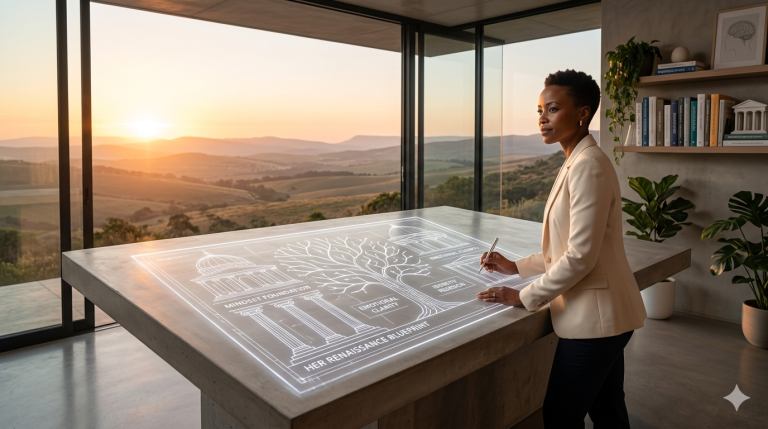
This is the foundational work of Her Renaissance. Transformation is not about adding more to an already exhausted self. It is not about acquiring more certificates, reading more books, or piling more expectations onto a fragile foundation.
Transformation is an unburdening. It is a systematic stripping away of the identities, beliefs, and behaviors that do not belong to your future.
When you stop viewing yourself as a broken project that needs constant fixing, something beautiful happens. The shame evaporates. You stop fighting yourself and start understanding yourself. You look at your patterns not with anger, but with a clinical, compassionate curiosity. You begin to ask: What program is running right now, and is it serving the woman I am becoming?
Building a new blueprint means consciously deciding what rules you are going to live by. It means writing new lines of code that support your expansion rather than your restriction.
- Instead of “I have to be perfect to be accepted,” the new code becomes “My authority is rooted in my truth, not my perfection.”
- Instead of “I am too late,” the new code becomes “My timing is sovereign, and my experience is my equity.”
You have the capacity for immense power, deep emotional mastery, and an impact that ripples through every area of your life. The hardware is already there. Your intellect, your heart, your ambition—they are fully capable of holding the magnitude of the life you want to build. You just have to give them an environment where they can run smoothly.
The System Reset
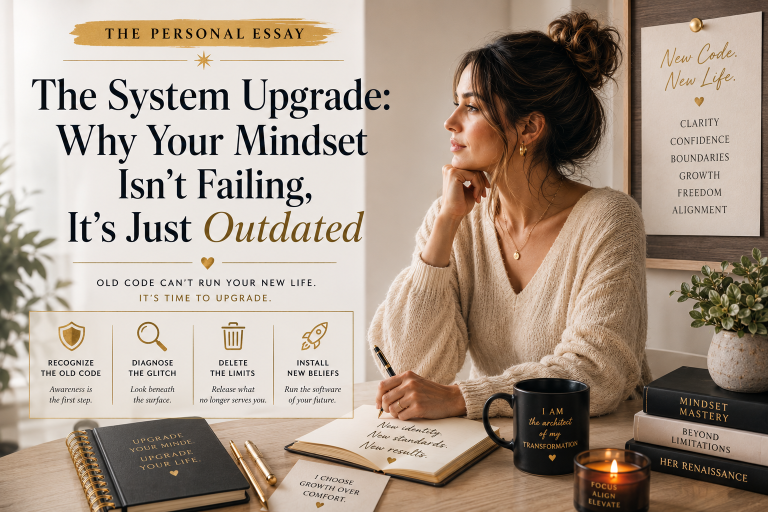
If you are reading this and feeling that familiar stir in your chest, let this be your official notification that a system upgrade is required.
The errors you are experiencing—the procrastination, the self-doubt, the hesitation, the quiet frustration of knowing you are capable of so much more—are not proofs of your inadequacy. They are simply systemic notifications telling you that you have outgrown your current framework.
You cannot step into your next era using the map of your past. The woman you are meant to be cannot survive in the tight, defensive container built by the woman you used to be.
It is time to close out the old programs. It is time to clear the cache of old grievances, old failures, and old definitions of what is possible for you. You are not broken. You never were. You were just operating under a set of rules that are far too small for the reality you are about to create.
Welcome to your reset. The upgrade begins now.