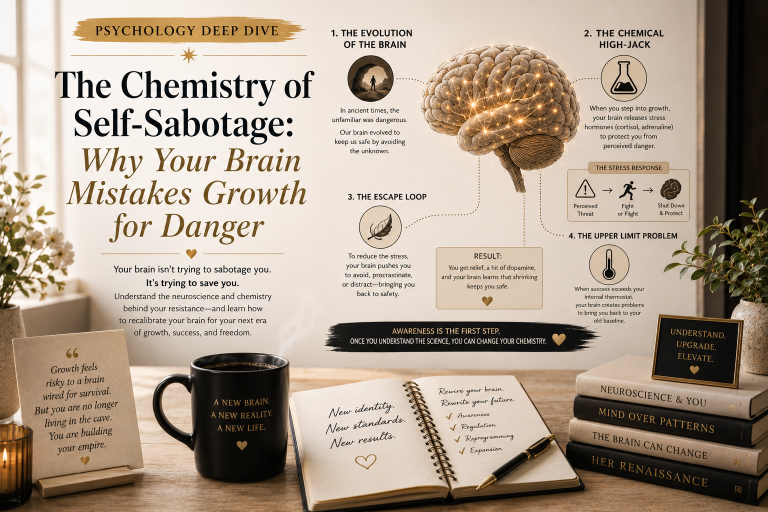

The System Upgrade: Why Your Mindset Isn’t Failing, It’s Just Outdated
We have all been conditioned to believe that when we stall, it is a moral failing.
We look at our unfinished projects, our abandoned habits, and the goals we loudly declared in January that lie gathering dust by June, and we draw an immediate, damaging conclusion about our character. We tell ourselves we lack discipline. We decide we don’t want it badly enough. We internalize the frustration until it hardens into a definitive belief: I just don’t have what it takes.
But what if the resistance you are feeling isn’t proof of a flawed character, but evidence of an outdated system?
When you decide to make a radical shift in your life—whether that is launching a new business, setting firm personal boundaries, or stepping into a room with a brand-new level of unshakeable authority—you are attempting to run a highly sophisticated piece of personal software. You are asking your mind, your emotions, and your daily habits to execute a complex, high-energy program designed for expansion.
Yet, most of us are trying to run that brilliant, forward-facing software on a psychological operating system that hasn’t been updated since we were adjusting to high school, surviving our early twenties, or navigating our first major heartbreak. Your mindset isn’t failing you. It is executing its current programming flawlessly. The question is: who wrote that code, and when did you give them permission to run your life?
The Hidden Architecture of Safety
To understand why your current operating system rejects your growth, you have to understand its original purpose. Your subconscious mind has one primary directive: keeping you safe.
The problem is that your subconscious defines “safety” not by what is healthy, fulfilling, or prosperous, but by what is familiar.
Think back to the moments in your life when you felt the most exposed, judged, or vulnerable. Perhaps it was a childhood moment where speaking your mind resulted in sharp rejection. Perhaps it was an early professional experience where taking a bold risk ended in public failure. In those moments of high emotional stress, your brain did exactly what it was designed to do—it wrote a line of defense code to ensure you would never feel that particular pain again.
Those codes look like this:
- If I stay quiet, no one can criticize me.
- If I don’t finish this project, I can’t be judged on its success.
- If I keep everyone else happy first, they won’t leave me.
At twenty years old, that code might have been a brilliant survival strategy. It kept your head down, kept the peace, and protected your fragile, developing sense of self. But today, at this stage of your evolution, that exact same survival code acts as a digital virus. It is the invisible wall you hit every time you try to scale your income, share your authentic voice, or claim your true sovereignty. When you try to install the software of a visionary leader on top of an operating system ruled by old defense codes, a systemic conflict is inevitable. Your computer doesn’t crash because the new app is bad; it crashes because the internal architecture can’t support the load. Your self-sabotage is not a failure of willpower. It is your old system forcing a hard shutdown to keep you within the historical boundaries of your safety zone.
The Diagnosis: Spotting the Glitch
You cannot rewrite code you cannot see. The first step in a true system upgrade is transitioning from blind frustration to precise, clinical observation.
When a software engineer encounters a bug, they don’t scream at the screen or accuse the computer of being lazy. They run a diagnostic test. They look for the exact line of code causing the conflict.
As a woman committed to her own rebirth, you must become the engineer of your own mind. When you notice yourself procrastinating on a critical task, or when you feel that familiar wave of imposter syndrome rising up to choke out your confidence, stop and run the diagnostic. Instead of spiraling into shame, ask yourself: What old rule is my system trying to enforce right now?
You will often find that the voice of your self-doubt isn’t actually yours. It is the echo of an old teacher, a critical parent, an insecure ex-partner, or a younger, terrified version of yourself who was just trying to survive a bad winter. Realizing that your limiting beliefs are just historical programming—and not absolute, objective truths—is the moment the cage door unlocks. A belief is not a fact; it is simply a thought you have rehearsed until it became automatic. And anything that has been programmed can be systematically deprogrammed.
Stripping the System to Build Your Power
True personal transformation within Her Renaissance is never about adding more weight to an already exhausted structure. It is not about buying another self-help book, downloading another productivity app, or forcing yourself to endure a grueling routine that leaves you hollowed out.
True transformation is an unburdening. It is a systematic stripping away of the identities, defense mechanisms, and outdated rules that you have outgrown.
Imagine how much mental bandwidth you would free up if you stopped negotiating your worth every single morning. Imagine the speed of your execution if you cleared out the background noise of needing everyone else’s permission before you made a move.
When you upgrade your operating system, you aren’t changing who you are at your core. You are actually doing the deep, necessary archaeology to rescue who you have always been from beneath the layers of protection you piled on top of yourself. You are clearing the cache. You are deleting the files that tell you that you are too late, too loud, too much, or not enough. You don’t need a new brain, a new personality, or a new life history. Your current hardware—your intelligence, your depth, your ambition, and your lived experience—is magnificent. It is fully capable of holding the weight of the massive life you want to build. You just need to give that hardware an environment where it can run without friction.
Executing the Upgrade
The moment you accept that you are the programmer and not the program, everything changes. You no longer have to live at the mercy of a blueprint you did not consciously choose.
This month, as we lay the internal foundation of your next era, your only assignment is to stop fighting your old system and start rewriting it. When an old, limiting program flashes across the screen of your mind, look at it with a calm, compassionate authority. Acknowledge that it kept you safe for a long time, thank it for its service, and then firmly hit delete.
Write the new lines of code that your future self requires:
- My visibility is my currency.
- My boundaries are the guardrails of my brilliance.
- I do not owe the world my exhaustion.
The errors you are experiencing right now—the hesitation, the friction, the quiet restlessness in your soul—are not signs that you should stop. They are your system notifications telling you that you have officially outgrown your current framework. The container is too small for the woman you are becoming.
The prompt is on your screen, and the choice is entirely yours. You can keep hitting “remind me later,” or you can click install and watch how fast your reality shifts.
The upgrade begins right now.