
What is a limiting belief, really? The neuroscience of why they feel like facts.
What is a limiting belief, really? The neuroscience of why they feel like facts
If you have spent any time in the personal development space, you have heard the phrase limiting belief tossed around a thousand times. It has become a standard piece of self-help jargon, usually accompanied by a superficial instruction to simply “change your thoughts” or “manifest a new reality.”
But if changing a limiting belief were as simple as realizing it was bad for us, you wouldn’t be sitting here reading this.
You wouldn’t still feel that icy spike of anxiety in your chest when it’s time to raise your prices. You wouldn’t find yourself staring at a blank screen for three hours, rearranging paragraphs on a proposal because a quiet, insistent voice is telling you it isn’t perfect yet. You wouldn’t watch yourself retreat into the background of a room you are entirely qualified to lead.
When you are in the thick of a limiting belief, it doesn’t feel like a “flawed thought pattern.” It feels like reality. It feels like gravity. If you believe “I am not ready for this level of success,” your brain doesn’t flag that thought as an insecurity—it presents it to you as an absolute, objective, unshakeable law of nature.
To break free from these mental cages, we have to stop treating them as moral failures or spiritual blocks. We need to look under the hood. We need to understand the cold, hard neuroscience of why our brains are wired to turn old fears into absolute facts.
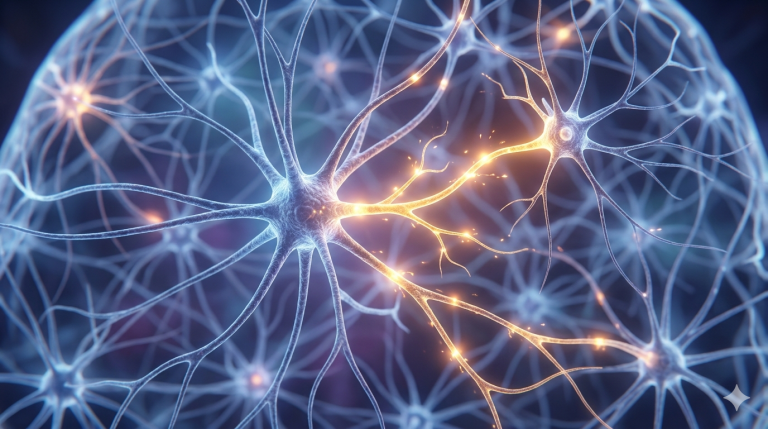
The Architecture of the Neuro-Highway
Your brain is a highly sophisticated, energy-conserving organic supercomputer. Weighing only about three pounds, it consumes roughly 20 percent of your body’s total energy. Because running the human body is so metabolically expensive, the brain’s primary operational goal is efficiency. It loves shortcuts.
When you think a thought for the first time, a group of neurons fires together, creating a tiny, fragile electrical pathway. If you never think that thought again, the pathway fades. But if you repeat that thought—if you rehearse it, analyze it, and emotionalize it—something remarkable happens beneath the skull.
The brain triggers a process called myelination. A protective, fatty sheath called myelin begins to wrap around that specific neural pathway, acting like insulation on an electrical wire. Each time the pathway fires, the insulation thickens.
Eventually, that tiny, fragile footpath becomes a high-speed, multi-lane neuro-highway. Information travels down a myelinated pathway at speeds of up to 200 miles per hour. The thought becomes so highly automated that it skips your conscious awareness entirely. It becomes a default setting.
A limiting belief is simply a highly myelinated neural pathway. When you look at your business, your bank account, or your relationships and think, “I can’t handle this,” your brain doesn’t have to deliberate. It drops down into that deeply grooved, lightning-fast highway. Because the thought happens so fast and with zero conscious effort, your nervous system processes it as an absolute truth. It feels like a fact simply because it is the path of least resistance for your biology.
The Reticular Activating System: Your Subconscious Gatekeeper
The neuroscience of a limiting belief goes deeper than just insulated pathways; it actively distorts how you perceive the physical world around you.
Deep within your brainstem lies a dense network of neurons known as the Reticular Activating System (RAS). The RAS acts as the ultimate gatekeeper of your consciousness. At any given millisecond, your senses are bombarded with roughly 11 million bits of environmental data. If your conscious mind tried to process all of it, your brain would instantly short-circuit.
To protect you, the RAS filters out 99.9 percent of the noise, allowing only the information that it deems strictly necessary or relevant to pass through into your awareness.
And how does the RAS determine what is relevant? By looking at your dominant, rehearsed beliefs.
If your underlying operating system is running the code “People in my industry will think I’m an imposter,” your RAS goes to work like a highly trained digital algorithm. It actively scans every room, every email, and every social media comment for evidence to validate that specific script.
If ninety-nine people praise your work, but one person gives you a lukewarm response, your RAS will completely filter out the ninety-nine and hyper-focus on the one. It will amplify the criticism, dim the praise, and present you with a curated reality that says, “See? I told you so. You don’t belong here.”
Your limiting belief feels like a fact because your brain is literally hiding the counter-evidence from you. You aren’t seeing the world as it is; you are seeing the world as your operating system has been programmed to filter it.
The Somatic Anchor: Why Logic Fails
This is why traditional self-help advice often leaves women feeling more broken than before. You try to use logic to override an insecurity. You write down positive affirmations on sticky notes and paste them to your mirror. You tell yourself, “I am a wealthy, confident woman.”
But the moment you sit down to execute, your stomach knots up, your throat tightens, and a wave of dread washes over you. Your logic says one thing, but your body says another.
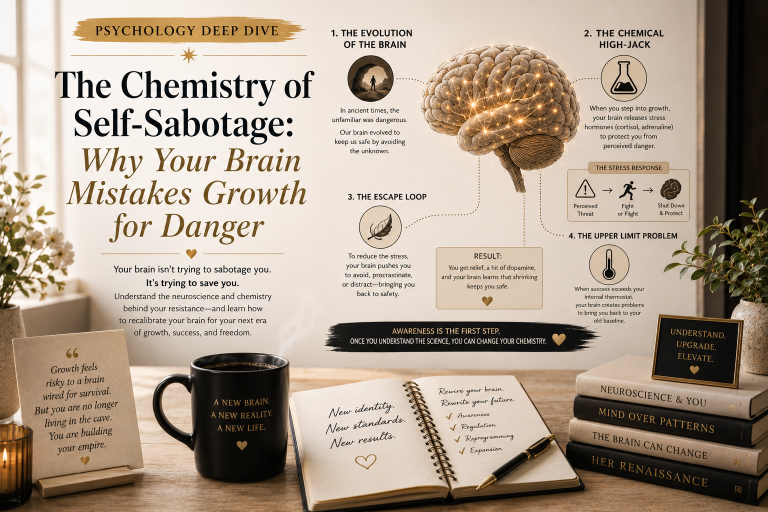
This happens because a limiting belief is not just a cognitive sentence; it is a somatic loop. When a neural pathway fires with an ancient fear, it instantly signals the amygdala—the brain’s emotional smoke detector. The amygdala fires up the sympathetic nervous system, flooding your bloodstream with cortisol and adrenaline.
Your heart rate increases. Your breathing becomes shallow. Your biology goes into a survival state of fight, flight, or freeze.
Once your body is in a state of physiological threat, your prefrontal cortex—the seat of logic, strategy, and vision—effectively goes offline. Your brain cannot distinguish between the threat of a predatory animal and the threat of an uncomfortable email. It just knows you are in danger.
When your body feels like it is dying, no amount of positive thinking will convince it otherwise. The belief feels like an undeniable fact because it is anchored by a real, physical, chemical reaction inside your cells.
Rewriting the Biological Script
Understanding this neuroscience doesn’t mean you are trapped by your biology; it means you finally have the blueprint to change it. This is the core of Identity Archaeology inside Her Renaissance. We stop fighting the thoughts on the surface and start disrupting the neural wiring underneath.
You do not need to fix a broken spirit. You need to de-myelinate an old pathway and construct a new one.
When you understand that a limiting belief is just automated code running on a biological loop, the shame disappears. You can watch the anxiety rise, observe the throat tightening, and say with a calm, compassionate authority: “My nervous system is experiencing a false alarm. This is not a fact. This is just an old pathway trying to save energy.”
By stepping into the role of the observer, you create a microscopic pause between the stimulus and your response. In that pause lies your sovereignty. Each time you feel the somatic pull of an old belief and choose to take one deep, regulated breath and take action anyway, you scratch the record. You disrupt the automated loop.
You strip the power from the old neuro-highway, and you lay down the very first brick of a brand-new blueprint. It will feel clumsy at first. It will require conscious effort. But with repetition, the brain will insulate the new path. The truth will eventually become your new default.
You are not standard-issued software. You are the architect of the machine. It’s time to take back the controls.
If you are interested in getting one on one coaching, contact me on angelique@herrenaissance.co.za or if you prefer your own pace take a look at the courses we have available.